What top creators in the auto niche post every week (competitor analysis)
We broke down the weekly output of the biggest auto creators — the formats, the cadence, and the exact mix of hooks, skits and builds you should copy.
Omar Haddad
·7 min read
Top auto creators don't post randomly. Their weeks follow a repeatable mix: a couple of high-reach skits or POVs for the top of funnel, one build or detail video for depth, and one direct “buying advice” piece that converts. Here's the pattern — and how to see it for any account in your niche.
Key takeaways
- The winning auto cadence is roughly 60% reach (skits/POVs), 25% depth (builds), 15% conversion.
- Reach content rides trending sounds; conversion content answers a buying question.
- Consistency of FORMAT matters more than volume.
- SFOM.AI tracks competitor accounts and surfaces their best-performing posts automatically.
The weekly mix that works
- Reach (≈60%): relatable skits, POVs and “left/right” trend jacks on trending audio.
- Depth (≈25%): a build, a detailing transformation, or a “what broke and why” teardown.
- Conversion (≈15%): “don't buy this car until you check X” — a buying question answered.
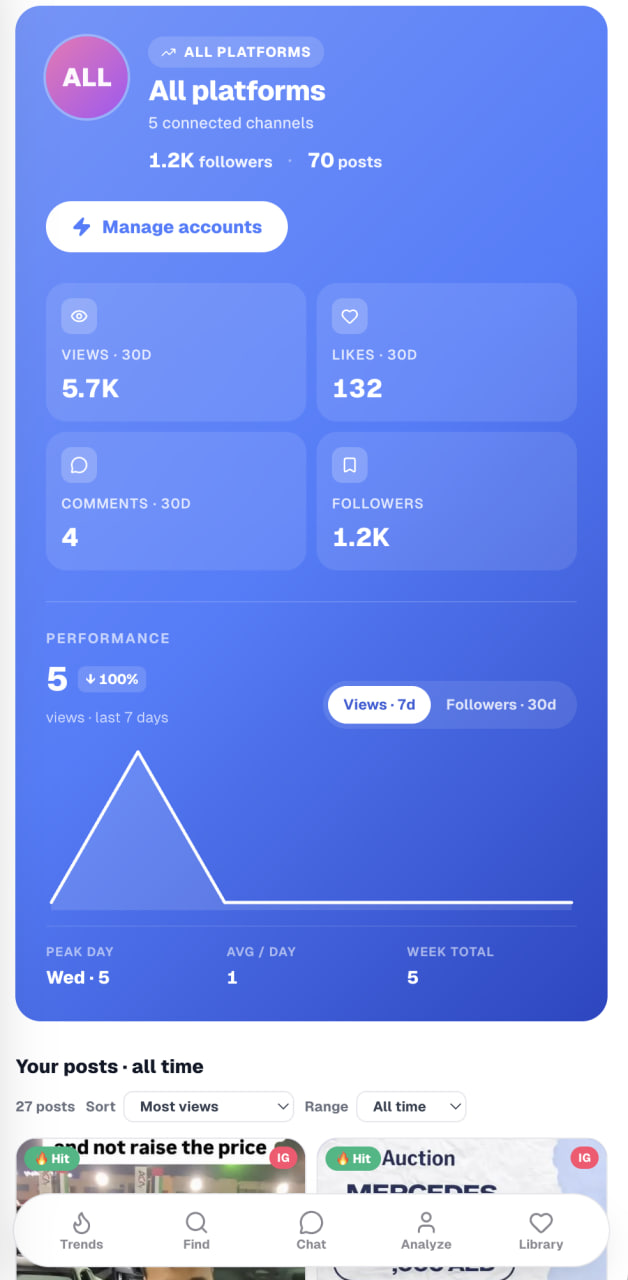
See the viral posts in YOUR niche
SFOM.AI watches Instagram, TikTok and YouTube and surfaces the posts beating their own author's median — with an AI breakdown of why each one worked, and a one-click script in your voice. Cancel any time.
Find my viral ideasReach content: rent the audience
The top-of-funnel posts almost always ride a trending sound plus a simple, repeatable visual. Think the “Left Right” (#letmedrive) format a Medina café rode to 1.8M views — the auto niche does the same with a dealership skit or an owner-reaction bit. Low production, high shareability.
Depth content: earn the trust
A weekly build or teardown is what separates a channel from a meme page. It signals expertise, keeps your core audience, and gives you evergreen watch-time. It won't always go viral — that's not its job.
Conversion content: cash the trust in
Once a week, answer the question a buyer actually types: “is this car reliable,” “what to check before you buy.” This is where the audience you rented and the trust you earned turn into DMs and sales.
You don't need to out-post the top creators. You need to out-structure them — same mix, your niche, every week.
How to reverse-engineer any competitor
Paste a competitor's handle into SFOM.AI and it pulls their whole account: follower growth, top posts, and the formats that repeat. Track a few accounts and the weekly pattern becomes obvious — then you copy the structure, not the content.
How often should auto creators post?
3–5 times a week with a consistent format mix (≈60% reach, 25% depth, 15% conversion) beats posting daily with no structure.
How do I analyze a competitor's content?
Paste their handle into SFOM.AI. It surfaces their top posts, follower growth, and the repeating formats so you can copy the structure that works.
What content converts in the auto niche?
Buying-decision videos — “what to check before you buy,” reliability breakdowns — convert best because they meet a buyer at the moment of intent.
Read next
Related articles
Google Trends alternatives, grouped by the question you're actually asking
Most roundups list the same twelve tools with the same vendor copy. The reason people search for a Google Trends alternative is simpler than that: it measures search demand, and they need to see what is happening on social. Here is which tool answers which question — including where we do not fit.
A still photo beat 99.5% of the reels we track
A burger photo pulled 2,425,971 likes — 3,426× the median post in our index of 22,118, and inside the top 0.5% of everything we measure. It is not a reel. No motion, no sound, no trending audio. Here is the mechanism, and what the distribution actually looks like.
A broker put a jump scare in front of his price. It worked.
A Brazilian realtor opened with a POV drive, cut to a jump scare, and revealed a price per square metre. 85,110 views — modest next to the 31M the same mechanism pulled in restaurants, and that is exactly what makes it worth copying: the format travels, and real estate has barely touched it.