12 video hooks that are actually working right now (with real examples)
The opening lines stopping the scroll in 2026 — pulled from real high-view videos, grouped by the psychology that makes them work, with a template for each.
Maya Chen
·8 min read
A hook is the first 1–2 seconds of a video — the line or image that decides whether anyone watches the rest. In 2026 the hooks that work aren't clever; they're specific, they create a gap the viewer needs closed, and they promise a payoff fast. Here are 12 patterns pulled from real high-view videos, with a fill-in template for each.
Key takeaways
- Hooks win by creating an open loop — a question or claim the viewer needs resolved.
- Specific beats impressive: “the $3 fix” outperforms “the best fix”.
- Pattern-interrupts and POVs travel across every niche.
- SFOM.AI labels the hook on every breakdown so you can steal the pattern, not the topic.
The 12 hooks
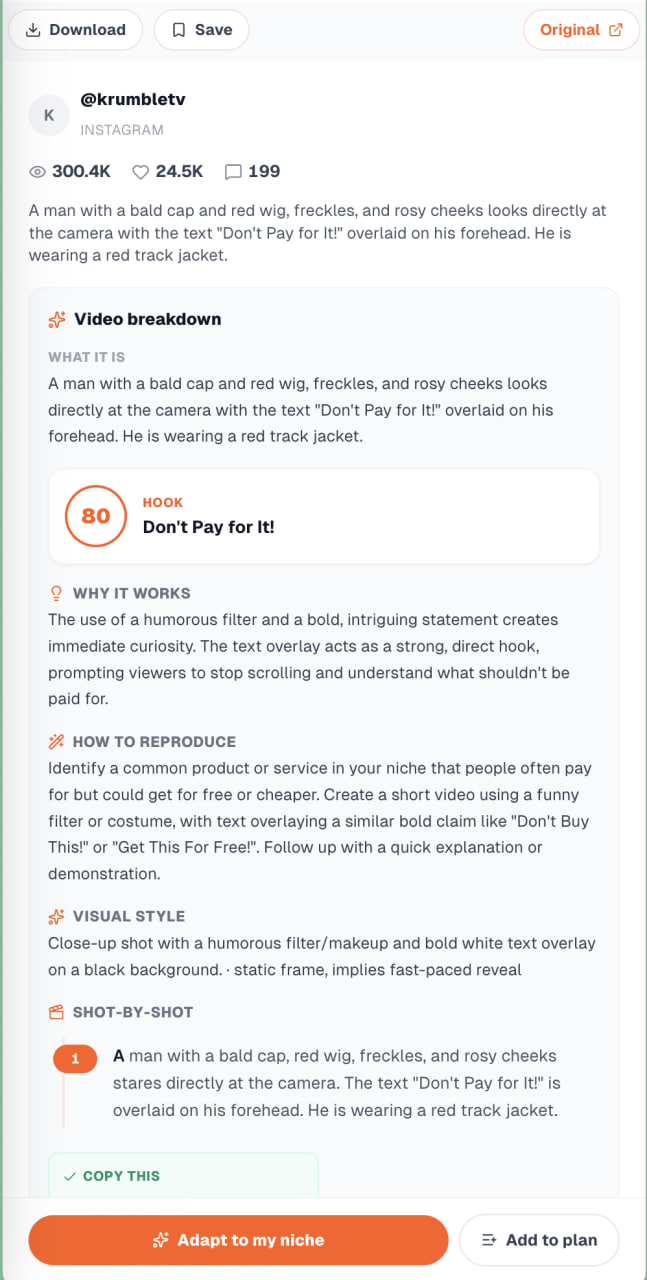
- The bold claim: “This costs $3 and works better than the $300 version.”
- The pattern interrupt: start mid-action, no intro, no “hey guys”.
- The POV: “POV: you forgot to feed the dog and now he's in your mirror.”
- The mistake call-out: “You're doing this wrong and it's costing you views.”
- The listicle promise: “3 things I'd never do as a realtor.”
- The before/after tease: show the after in second one.
- The forbidden knowledge: “They don't want you to know this.”
- The relatable fail: “When you forget you're over thirty.”
- The number shock: “I made $12k from one 8-second clip.”
- The direct question: “Why does nobody talk about this?”
- The this-vs-that: “Left or right — which would you pick?”
- The countdown: “Save this before it's gone.”
See the viral posts in YOUR niche
SFOM.AI watches Instagram, TikTok and YouTube and surfaces the posts beating their own author's median — with an AI breakdown of why each one worked, and a one-click script in your voice. Cancel any time.
Find my viral ideasWhy these work: the open loop
Every hook above opens a loop the brain wants to close. A bold claim demands proof. A POV drops you into a scene mid-tension. A mistake call-out makes you check whether you're the one making it. The video then pays off the loop — which is why watch-time (and reach) follows.
Specific beats impressive
“The best morning routine” is a scroll-past. “The 90-second routine I stole from a Navy pilot” is a stop. Numbers, names, and dollar amounts make a hook feel true. When you adapt a hook, add the most specific detail you honestly can.
If your first line could apply to any creator in your niche, it will perform like every creator in your niche.
How to steal a hook the right way
Steal the pattern, not the sentence. Open any high-view video in SFOM.AI and the breakdown labels which of these patterns it uses and why it landed. Copy the structure, then fill it with your own specific, true detail. That's the difference between derivative and adapted.
What makes a good video hook in 2026?
A good hook opens a loop in the first 1–2 seconds — a bold claim, a POV, or a specific number — that the viewer needs resolved. Specificity (names, dollar amounts, timeframes) beats vague superlatives.
How do I find the hook of a viral video?
Open the video in SFOM.AI's breakdown — it labels the hook, the structure, and why it worked, so you can reuse the pattern in your niche.
How many hooks should I test?
Rotate 3–4 hook patterns per week and keep the ones that beat your baseline watch-time. Treat hooks as your highest-leverage variable.
Read next
Related articles
Google Trends alternatives, grouped by the question you're actually asking
Most roundups list the same twelve tools with the same vendor copy. The reason people search for a Google Trends alternative is simpler than that: it measures search demand, and they need to see what is happening on social. Here is which tool answers which question — including where we do not fit.
A still photo beat 99.5% of the reels we track
A burger photo pulled 2,425,971 likes — 3,426× the median post in our index of 22,118, and inside the top 0.5% of everything we measure. It is not a reel. No motion, no sound, no trending audio. Here is the mechanism, and what the distribution actually looks like.
A broker put a jump scare in front of his price. It worked.
A Brazilian realtor opened with a POV drive, cut to a jump scare, and revealed a price per square metre. 85,110 views — modest next to the 31M the same mechanism pulled in restaurants, and that is exactly what makes it worth copying: the format travels, and real estate has barely touched it.